Christian Muslim Forum webinar held on 25th November 2026 explored how interfaith dialogue can help young people navigate division, misinformation and social change
In its invitation, Christian Muslim Forum wrote that young people are facing unprecedented challenges with the rise of AI compounding struggles faced in employment and education. Data shows young people are engaged but alienated, are at ease with social and cultural diversity but lack faith in institutions, and are disillusioned about contemporary politics addressing the issues that matter to them. At the same time, young people face an erosion of 'community infrastructure' that enables civic life to flourish.
Faith institutions can provide opportunities and spaces for such a civic life to form and develop. What role can interfaith dialogue play in supporting young people navigate social challenges, including rising populism, with confidence and openness to learning about the other?
These themes framed the online discussion, after the presentations from Jill Appleton, National Director of The Feast, and Rukshana Akhtar, Hub Manager for The Feast in Tower Hamlets.
Building resilience through dialogue
Introducing the discussion, participants reflected on concerning misconceptions about minority communities in Britain. Such misunderstandings, often reinforced by media narratives and social media, can shape attitudes toward others and contribute to fear, mistrust and division.
Drawing on almost two decades of experience, Jill Appleton explained how The Feast was established to create opportunities for young people of different faiths to meet, talk and build friendships through structured dialogue.
She described how the organisation's approach emerged from a simple but transformative question posed to a young person: “What do you love most about your faith?” Rather than debating differences, the question invited sharing, listening and mutual respect.
Today, The Feast intentionally equips young people with practical skills for dialogue through a set of dialogue guidelines that emphasise respectful listening, asking rather than assuming, and creating space for differing perspectives. These skills are increasingly important in an age when many young people are exposed to highly polarised voices online.
"Young people are surrounded by noise," Jill observed. "The person who shouts loudest is often the person who gains influence. We want to give young people the confidence and skills to have conversations that are respectful, thoughtful and rooted in understanding."
The organisation's vision, she explained, is to nurture resilient young people who are confident in their beliefs and identity, able to build meaningful friendships across differences, and committed to contributing positively to society.
Friendship as an antidote to fear
A recurring theme throughout the discussion was the transformative power of encounter.
Through activities ranging from sports and community projects to meals and residential weekends, The Feast creates opportunities for young people from different faith backgrounds to spend time together before engaging in facilitated dialogue.
Jill Appleton stressed that the goal is not to reduce differences or persuade others to adopt particular beliefs. "We create spaces where young people can be open about who they are," she said. "Acknowledging difference is important. The things that make us different are often the things that matter most to us."
She shared the story of a young Christian man. Having been drawn towards gang culture in his early life, he encountered Muslim peers for the first time in a context of friendship and dialogue. That experience challenged assumptions he had previously accepted and, in his own words, altered the trajectory of his life. Stories such as these demonstrate how personal encounter can break down stereotypes more effectively than argument alone.
Challenging stereotypes through lived experience
Rukshana Akhtar illustrated this point through an example from The Feast's work in Tower Hamlets. During a visit involving thirty secondary school students to both a church and a mosque, one student remarked after hearing the Islamic call to prayer that he had previously associated the sound only with terrorism because of how it had been portrayed in films, but experiencing it within a mosque and observing worshippers gathering peacefully for prayer challenged that perception. This highlighted the extent to which perceptions can be shaped by media narratives and how direct experiences can help young people (and adults) develop a more informed understanding of others.
"One meaningful encounter can completely change the way someone sees the world," Rukhsana reflected. This shift from assumption to curiosity helps prevent conversations becoming confrontational and allows disagreement without hostility, which helps in unpacking the fear-based narratives about immigration, and diversity.
Beyond tolerance to genuine encounter
An important theme emerging from the discussion was the distinction between simply identifying common ground and genuinely engaging with difference.
Jill Appleton spoke candidly about her reservations regarding approaches to interfaith work that focus exclusively on similarities.
True friendship, she argued, does not require people to minimise or dilute deeply held convictions. Rather, it requires creating relationships strong enough to accommodate disagreement while maintaining mutual respect.
Hope for the future
The webinar concluded with reflections on the importance of investing in young people as agents of change.
Speakers emphasised that interfaith dialogue is not simply about increasing understanding between religious communities. It is about helping young people become more confident, resilient, empathetic and engaged citizens, and it is about learning to live well together.
By creating spaces where young people can ask questions, challenge assumptions, form authentic friendships and develop confidence in their own identities, organisations such as The Feast are helping to build a generation capable of navigating diversity with wisdom and compassion.
In a time marked by division, misinformation and growing social fragmentation, that may be one of the most important lessons young people can learn.
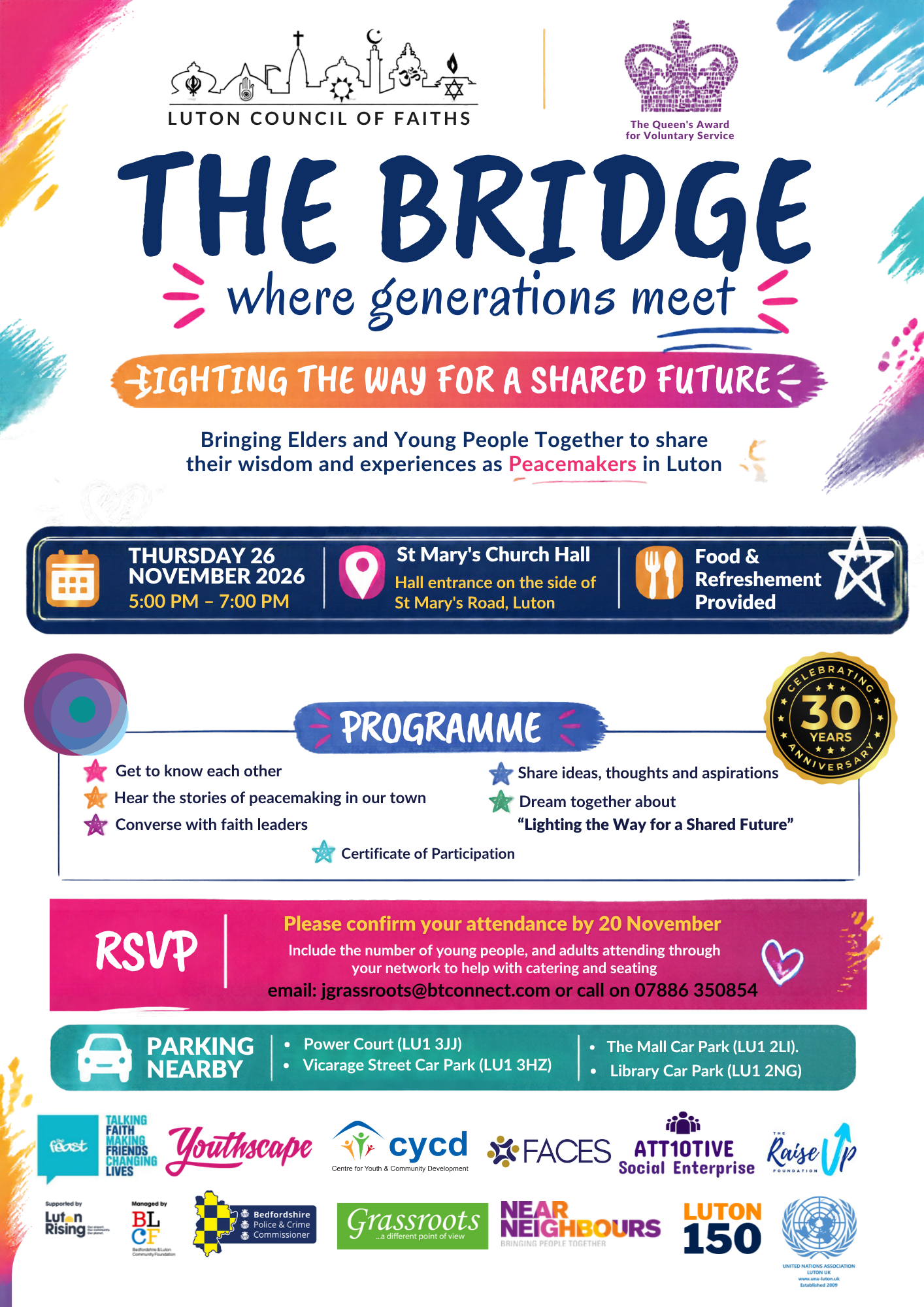
The Bridge – Luton Initiative
GRASSROOTS Luton Director, David Jonathan (Johny) talked about Inter Faith Week Event in Luton on 26th Nov 5-7pm at St Mary's Church, Luton LU1 3JF. This event brings together young people as well as faith leaders from Luton’s diverse communities. He said, “We will be thinking about how we can be active peacemakers in Luton as we ‘light the way together for a shared future’, the theme of this year’s Inter Faith Week.” He shared that young people from Luton’s different youth organisation have been invited to share their stories and experiences of bringing peace and wellbeing to our town, and also share any poetry/song/artwork on the themes of peace, and unity.