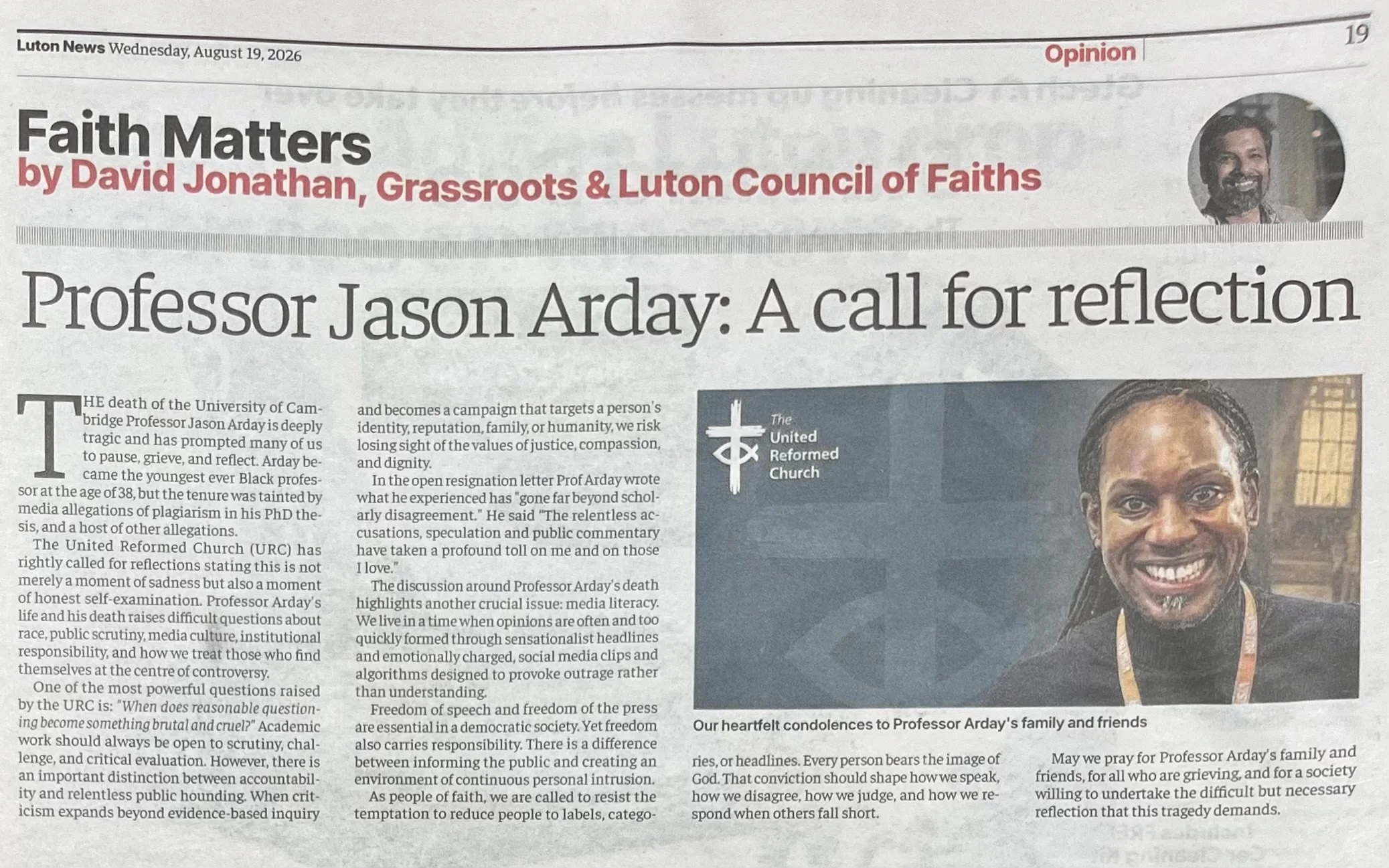
https://www.bbc.co.uk/news/articles/c1j1ye6n30no Jason Arday, ex-Cambridge professor at centre of plagiarism row, found dead 14 August 2026 | Updated 15 August 2026
The death of the University of Cambridge Professor Jason Arday is deeply tragic and has prompted many of us to pause, grieve, and reflect. Arday became the youngest ever Black professor at the age of 38, but the tenure was tainted by media allegations of plagiarism in his PhD thesis, and a host of other allegations.
The United Reformed Church (URC) has rightly called for reflections stating this is not merely a moment of sadness but also a moment of honest self-examination. Professor Arday's life and his death raises difficult questions about race, public scrutiny, media culture, institutional responsibility, and how we treat those who find themselves at the centre of controversy.
One of the most powerful questions raised by the URC is: "When does reasonable questioning become something brutal and cruel?" Academic work should always be open to scrutiny, challenge, and critical evaluation. However, there is an important distinction between accountability and relentless public hounding. When criticism expands beyond evidence-based inquiry and becomes a campaign that targets a person's identity, reputation, family, or humanity, we risk losing sight of the values of justice, compassion, and dignity.
In the open resignation letter Prof Arday wrote what he experienced has "gone far beyond scholarly disagreement." He said “The relentless accusations, speculation and public commentary have taken a profound toll on me and on those I love.”
The discussion around Professor Arday's death highlights another crucial issue: media literacy. We live in a time when opinions are often and too quickly formed through sensationalist headlines and emotionally charged, social media clips and algorithms designed to provoke outrage rather than understanding.
Freedom of speech and freedom of the press are essential in a democratic society. Yet freedom also carries responsibility. There is a difference between informing the public and creating an environment of continuous personal intrusion.
As people of faith, we are called to resist the temptation to reduce people to labels, categories, or headlines. Every person bears the image of God. That conviction should shape how we speak, how we disagree, how we judge, and how we respond when others fall short.
May we pray for Professor Arday's family and friends, for all who are grieving, and for a society willing to undertake the difficult but necessary reflection that this tragedy demands.
——————————————————————————————————————————————
Here are a few key responses to the above article published in the Luton News:
Dr Nazia Khanum OBE DL is an award-winning human rights activist, scholar and community leader. In her message on 20th Aug’26, she said:
Dear Johny
Hope all is well with you and your work. This is just to say thank you for using your column in Luton News re Professor Jason Arday. Indeed it is time for reflection and also action.
The University should not have accepted Prof. Arday’s resignation before confidentially investigating the truth of these allegations. If the allegations were substantiated, only then he could have been asked to resign confidentially. Instead, he was thrown at the media wolves to lynch him in a barbaric way. No consideration was shown for his mental health issues including his autism! His vulnerability was never taken on board by the University or the media. He was used and abused as a performing monkey first and then brutally hounded to death most publicly!
From my active experience of challenging racism in the UK since 1982, this was one of the most shameful examples of racial injustices that I have witnessed. Why do I feel that this won’t be the last!
———————————————————
Chris Bailey of Lewsey Christian Centre, a Pentecostal Church in Luton said, “Johny, Thank you for standing as you stood on this matter that is so dear to many - life is no longer seen as precious as we should. We are all fearful, unique and wonderfully made hence the vulnerability in each of us.
The news was received with deepest shock even Professor Arday's resignation was a regret.
We at Lewsey Pentecostal Church and the wider community were in deepest shock of the news especially having followed the systemic witch-hunt that was unleashed on this vulnerable soul which is of course not an isolated but now caught media attention however these witch-hunt went on for almost 3 years - backed by those seniors in the academia and the media - the police and the political system of us and them does not help where those who know the Truth no longer have a voice. It is a sad.
Over scrutiny and witch-hunt has discouraged many in the Black/Asian/Ethnic Minorities to take up senior level roles - Chuka Umunna and those in high profile posts including sports are constantly place under undue pressures and to extra point of suicidal tendencies which will continue.
May Professor Arday soul rest in peace. May the God Almighty forgive him and those who pushed him to the point of no return.
———————————————————
Bob Baker, a prominent community leader, youth worker, and director of Heritage Associates CIC in Luton, said:
Blessing Brother Johny ,
Thanks for shining a light on this systemic racial public lynching . Old habits die hard. Truth be exposed , we are all implicit and cannot deny that Evil destroys when ‘good’ people stay silent. Pray Professor Arday Soul at RIP . Kill the flesh but can’t kill the spirit’, Yet still we rise 👊🏽Love is stronger than Hate .
Take care Johny, keep up the good fight, God bless you.
———————————————————
Pastor Vincent Cox, Senior Pastor of the New Testament Church of God, Luton said;
Johny, I trust that you are well.
Thanks for sharing the article you wrote in response to the tragic, untimely death of Professor Jason Arday, and for the responses to your article. Your contribution is much appreciated; it captures the cultural climate of our day and clearly affirms the stance we, as people of faith, must take against this abhorrent trend, which, if left unchallenged, will fracture our society.
Growing up in this country, we are regularly reminded that, as people of African and Caribbean heritage, we will not be afforded the same privileges as others. Consider the media pushback against individuals such as Adeshola Mos-Shogbamimu and Akala, among others. Yet the scrutiny of Professor Arday’s accuser, Nathan Cofnas, known for his advocacy of scientific racism, is far less. Indeed, today a headline in the Daily Telegraph claims that the US ambassador to Belgium has called for Mr Cofnas’ reinstatement as an academic at Ghent University following his suspension in the wake of Professor Arday’s death. A demise that seems inextricably linked to the manner of Mr Cofnas’ relentless pursuit of Professor Arday.
How did Nathan Cofnas, who describes himself as a ‘Race Realist’ and is on record as saying that in a true meritocracy black academics would disappear from public life outside of sports and entertainment, gain such a prominent voice in this matter? For those still claiming this is not an issue of race, bear in mind that among other notable cases, a white Cambridge professor, who in 2023 was found guilty of plagiarising 12 entire pages word for word from two of his students, was deemed accidental, and he kept his post.
Whatever the facts surrounding the claims and counter-claims regarding Professor Arday, the circumstances of his death must prompt a substantive pause for reflection on how society, and particularly the media, investigate such instances.
. ———————————————————
Also read Luton’s Rehana Faisal’s Blog: https://faces.org.uk/the-moral-veil-professor-jason-arday-and-the-vulnerability-we-refuse-to-see/
Prof Anthony G. Reddie is a British theologian and academic. His Facebook Post on 18th Aug’26) said;
“Many thanks to friends and colleagues who have reached out to me to check I'm OK in wake of the media lynching of Professor Jason Arday. It is greatly appreciated. The silence of others is also noted. It has been a difficult time as the only full Black Professor in the Humanities of Oxford University, in addition to being the first ever Professor of Black Theology in the history of the University and the first ever Black Professor in the Theology and Religion faculty. I have had journalists threatening to dig into my life if I didn't speak with them. Others asked me if I were a diversity hire like Arday and do I think I deserve to be in such an elite institution like Oxford University. I have refused to speak with the media. As I reflect on the labyrinthine journey I've taken to get to Oxford University, it has hardly been meteoric. Mine has been a long and slow trek. By the time I was made a Professor by a British University in 2023, I had waited 23 years and produced 22 books, and over 80 peer review articles and book chapters and was Editor in Chief of the leading journal of its kind in the world. And yet still my post in Oxford is chronically under funded, and now to add insult to injury, journalists have the nerve to question my position. These are difficult times for Black academics in the UK.” Prof Anthony G. Reddie’s Facebook Post (18th Aug’26); He is a British theologian and academic
The following post is by the Bishop of Edmonton, N London, Anderson Jeremiah. 14th Aug’2026. It also captures the heart and soul of what has happened.
Bishop of Cryodon Dr Rosemarie Mallett also spoke: https://www.facebook.com/churchtimes/posts/pfbid0RtvaXDSp4WcG8mkUUtiAgBdxjAiATQCJ6xAiUgmkLhLBk1wkdruD7VUeKBnr9iATl
Here’s a prominent criminal defence solicitor and Director at Liberty Law Solicitors Attiq Malik’s social media post: https://www.facebook.com/watch/?v=1397236229139116
Vigil organised on Monday in Trafalgar Square, London – The Voice
PM Andy Burnham’s reaction to Jason Arday’s death – BBC News
https://licc.org.uk/resources/blame-dodging-in-the-face-of-tragedy/
Karen Campbell, Head of Global & Intercultural Church | The United Reformed Church Interview:
Karen and Neil spoke on Premier Christian Radio about the URC's response to Jason's tragic death and drew upon John 8:7. A recap of the interview on Premier Christian News included a powerful prayer written by the Revd Andy Braunston, Minister for Digital Worship. Read highlights of the interview.
Also read:
https://urc.org.uk/urc-racial-justice-advocates-urge-andy-burnham-to-honour-windrush-pledge/
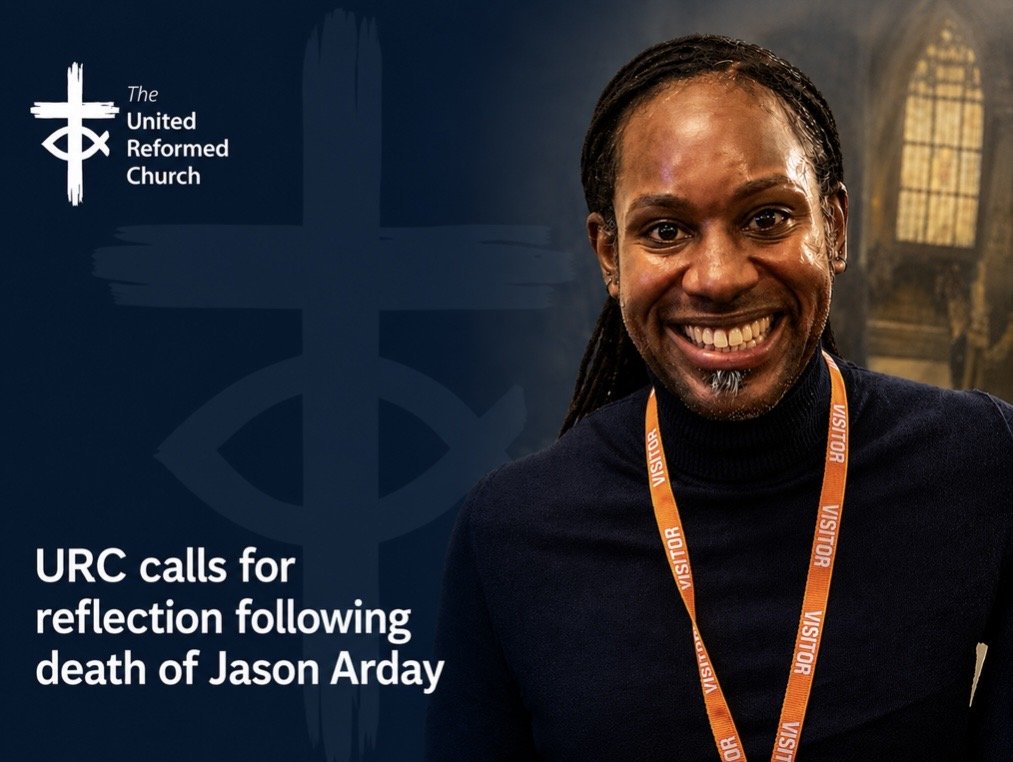
Our heartfelt condolences to Prof Arday’s family and friends (Pic Courtesey: United Reformed Church & ConiferousForest19, CC0, https://commons.wikimedia.org/w/index.php?curid=197515112)